
The After Purity After Party
Bring your pjs.

It’s been an amazing first week of having After Purity in the world, muted only by the 6-day grading marathon I just completed. So grateful to friends, colleagues, and readers who’ve already engaged the After Purity conversation, who’ve ventured out of the house after our first big snowfall to attend the local book launch, and who’ve organized an After Purity themed cake served on penis-shaped plates. Thank you for your warm affection and big hugs. And to Andrew, the shirtless guy on Goodreads, who gave it five stars, thanks for bringing the right vibes.

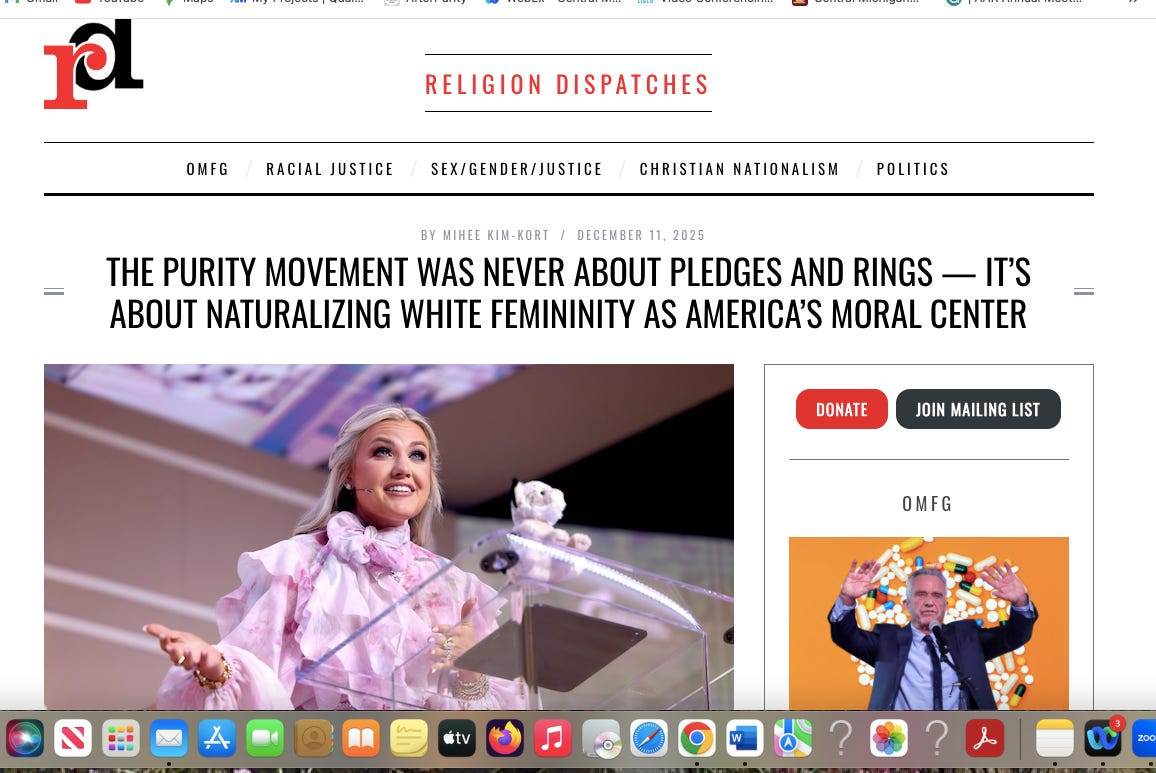
The best part of putting your ideas out into the world is seeing other people interact with them and push the conversation further. Pastor, author, and theologian, Mihee Kim-Kort draws connections to the MAGA movement in her article at Religion Dispatches, The Purity Movement Was Never About Rings—It Was About Naturalizing White Femininity As America’s Moral Center
“What the contrast between Erika Kirk and Usha Vance make visible is precisely what Moslener tracks in After Purity: that purity culture’s obsession with regulating femininity was always a racial project, one that positioned white womanhood as the moral anchor of the nation and cast other women in relation to it. Moslener shows that the language of “family values,” “protection,” and “biblical womanhood” has never functioned solely as theological construction; it has served as a political technology for defining who belongs at the center of American life and who must prove their fitness from the margins.”
Like a lot of people, I have personally struggled to keep apace the news cycle and the chaotic tornado that is the current administration. There is a part of me that feels frustrated by that lack of capacity, especially knowing that the work I do is so highly relevant to the very issues we are facing. But I also know that authoritarianism works by wearing us down and forcing us into a spiral of despair. For those of us already struggling with depression or any number of chemical imbalances that control our mental health and well-being, it is a time to tread slowly and make careful decisions about who and what we engage.
For this reason I am grateful for Mihee’s article which so expertly uses the After Purity argument to pinpoint the ways that tropes of femininity and race are being deployed to promote White Christian nationalism. Be sure to give it a careful read.
Here on Substack, Liz Bucar at Religion, Reimagined has written a really helpful review that helps us understand the ways that religion is ubiquitous in US culture, including spaces we perceive to be secular.
Evangelical teenagers (especially girls) learn that their bodies are fundamentally untrustworthy. Physical desires? Dangerous. Gut instincts? Probably leading you astray. The promptings of hunger, arousal, intuition? All suspect.
Sound familiar? It should, because this is the exact same logic that shows up in diet culture, wellness optimization, and pretty much every place where Americans are told their bodies need external management.
Bucar, a Religion Professor at Northeastern University, is currently working on a project that uses religion as a framework for understanding the trends and norms of contemporary wellness, fitness, and weight loss culture. In the last decade a post-purity recovery movement has grown exponentially as part of wellness culture, offering workshops on overcoming sexual anxiety, embodiment coaches who help people develop a working relationship with their bodies, basic sex-education for those who never got it, and all the accompanying literature and self-healed experts who’ve left White evangelicalism but not its entreprenurial spirit. It can be a mine-field, especially when you consider the impact of religious and sexual trauma. I’m excited to see where Bucar goes next with her analysis. See her full essay below.

.
So good. I’m indeed intrigued by what you report about Bucar. The relationship between American religion, especially evangelical style, which is everywhere, and American society and its power dynamics is all part of a whole. In other words, the more an evangelical professes to be apart from “the world,” the more they are playing into all that’s exploitative about “the world.”
This was also similar to colonial morality impositions in India and other parts of the British Empire:
https://substack.com/@macropsychic/note/p-181866959