
Underwear! Under where? Under there.
Portions of this essay are previously published in After Purity: Race, Sex, and Religion in White Christian America (Beacon Press: 2025)

I’m do not have a reputation for showing my underwear in public. But that doesn’t mean it hasn’t happened. At least four times. That I know of.
The second time I was on my way to the bus stop, cutting through Emory University School of Medicine and trying to avoid the boiling heat of Atlanta. I wore a cute dress and a backpack and I was lost. Once I started seeing patients on gurneys, I knew I had gone too far afield. I walked for far longer than I should have and by the time I made it back outside, I joined a crowd of dozens waiting for one of several buses. It was only then that I heard someone yell from behind me, “You got your backside hanging out.” I turned only an inch and knew the comment was meant for me. I immediately swung my backpack off and readjusted my dress to cover my offending parts. “No big deal,” I thought and walked toward my bus wondering how many patients caught a glimpse.
The third time was a bit harder to dismiss because it happened at a sacred, pilgrimage site. I had worn, once again, a cute dress and my backpack. A cute dress that was too short for walking up the hill to Newgrange, an ancient burial mound in Ireland re-claimed by archeologists for contemporary people to visit as sincere pilgrims or curious tourists. I earnestly believed myself to be the former.
Newgrange is a well-established UNESCO heritage site. It offers a lottery every year allowing winners to enter the inner chamber at sunrise on the winter solstice. The ancient people who built it, designed it as a passage tomb so that on the solstice the interior was entirely illuminated by the rising sun. I don’t know if the purpose had something to do with the dead who were buried there, a yearly ritual to send the dead further on their journey. Or if it was like a lot of spiritual geography of Ireland, designed to provide a calendar, giving agrarian societies much needed information about how soon winter would end and they could start growing food again.
My relationship with Newgrange started long ago, long before I even knew what it was. After having completed ten years of the academic study of religion, the image of the triple spiral remained one of the few spiritual artifacts of my life that still captured my awe. I had once been asked to draw a timeline of my life. Instead of a line, I drew a set of three spirals. When I finished my PhD, I had a triple spiral tattooed on my ankle as a way to mark the accomplishment. I thought about the image for a decade not certain where it came from and what meaning it might hold to those who etched it into stone.
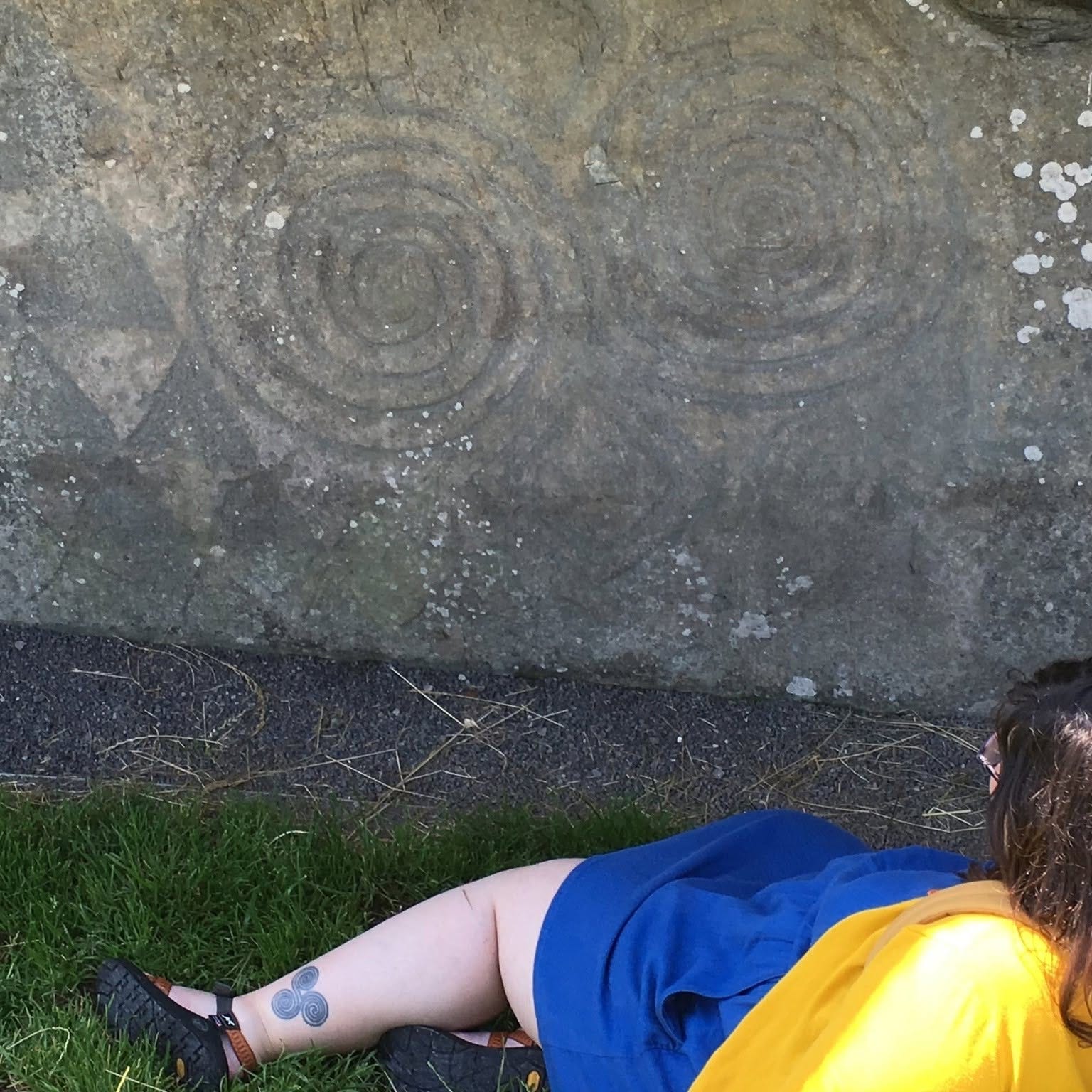
Pilgrimage to Newgrande, County Meath, Ireland. 2019
By the time I had placed my hands on the center of an ancient spiral carved into the stone I had already forgotten about my public spectacle. That is the grace of the dead. In my eagerness I had forged ahead of the crowd toward the stone mound. Again, a voice behind me, “Your skirt is sliding up!” Again, I knew. It was me. I adjusted and continued on my pilgrimage.
But it was the first time that should have solidified my reputation and almost did. It’s an even more difficult story to tell because I carried it with me for decades. More difficult because it required me to believe something about myself that turned out was based on a fabrication of my memory: by the age of six I was obsessed with the attention of boys so much that I invited them to look up my dress see my underwear. Unlike my adult self who could shake it off, six-year old Sara Jean was not prepared to have her first grade teacher accuse her of showing the boys her underwear in the cloak room. It created a story for me about myself and my heterosexuality that I accepted without question. Another young girl socialized too early into “the world” that demands she seek the attention of boys and men at all else. It wasn’t an original story, in fact it’s the beginning of many about girls and women led astray. The prodigal daughter who didn’t just leave but was exploited because of her innate need to be seen and admired in some way. She was always desiring and therefore always culpable.
I began learning this particular lesson at the age of six when my first-grade teacher at the small, parent-run Christian school I attended pulled me and my friend, Michelle, into the hallway. She had us sit with her on the worn marble steps leading upstairs to the older grades while she explained that we had done something wrong. I don’t recall her words, but I recall the humiliation of being pulled out of class to be reprimanded. Michelle and I had let boys see our underwear. I had been in the cloak room, standing with my legs spread between a shelf and the coat rack, letting them look under my dress. Miss Marshall may have said something to us about how to properly behave when wearing a dress, about keeping parts of our body hidden, about boys and their curiosity. Her particular lesson is lost to memory, but for decades the memory of that cloakroom held my deep shame. And the cloakroom was just one site of my boy-crazy behavior in my first grade year.
During recess, I would play a game with a fifth grader named Travis. Our school basement was a brown concrete box, the walls lined with thick athletic mats that were used during gym class and kept the more rambunctious boys from a skull-cracking collision. I was especially captivated by Travis, his lack of fear and freedom of movement. While he played basketball with other boys, I would hide away like a kidnapped princess. I’d wait for a pause in his game and then yell “Travis! Come save me!” My hero would exit the court and race toward me, pick me up from my invisible prison and carry me to the safety of the small, steel jungle gym, the one place in the basement where I mastered my own physical dexterity. When I got tired of that exertion, I could count on Travis and my imagination to take me to a less-brown, less concrete world where I was important enough to have my fictional requests for salvation taken seriously.
For decades these memories haunted me as if it indicated a deep-seeded need for a male companion and savior. Without realizing it, the scriptures I was required to memorize in school began filling in the spaces that were left hollow with shame. They fit nicely. In the story of the Garden of Eden, Eve’s punishment from God is not the same at Adam’s. “Your desire will be for your husband and he will rule over you” is Genesis 3:16. Sin had entered the world and the possibility of a world where women lived in harmony with men and their own bodies was lost. For women, the loss was greater, a point that the Apostle Paul would later amplify in the New Testament to argue that women are spiritually inferior, emotionally incomplete, and a collective nuisance in need of reminders to be silent. For me this meant anticipating a life of depending on men for various forms of personal fulfillment and security, a romantic relationship leading to marriage the mark of my success. I would live by the curse, obey where Eve disobeyed, and be rewarded with the man who would care for me and keep me safe.
Shame does powerful work with our memories. I was a bad princess who had to demand attention from boys and at the age of six was willing to perform to male sexual curiosity for that attention.
But sometimes the veil of shame is lifted when our memories return as if muscle memory is emerging from a hidden storage unit in the body. My six year old legs climbing a shelf, a daring lunge to bridge the gap between the shelf and a bar of the coat rack. I stood arms and legs spread, feeling large and powerful. And then I jumped, arms in, legs in. To the ground. Then started climbing up to do it all over again. I did this with my friend Michelle. We’d face each other because it gave us courage, the synchronicity of our movements emboldening our bodies. It was during this gymnastic feat that the boys entered the cloakroom, peeking around the door with curiosity and a little bit of envy. Again, we jumped to the floor proud of our physical feat.
So much of how we show up in the world is about the stories we believe about ourselves.
I held two versions of my first-grade “transgression” in my body for decades, but only one was audible to me. I learned that day on those school steps that my body held secrets I didn’t yet understand, secrets that boys were apparently desperate to know. What was under there? I imagined them saying with a glints and gleams in their eyes, eyes that seemed to follow me through the years as my body changed and as my own desire for goodness and need for safety surmounted any sexual desire of my own. Instead of learning that attraction and heartbreak were an indication of living and not, of losing, my complicated feelings of sexual desire encouraged me to build a fortress whose centurions diligently patrolled for sexual danger.
Fear flattens everything and creates a moral clarity that can’t be denied. Fear of predators, of betrayal, of your own needs. It’s ways easier than wading into the waters of complicated living, where writing about your underwear becomes a metaphor so apt its worth the embarrassment. This, I’m learning, is what it means to be a writer. To accept the inspiration as it comes. Even if it did, as it did today, come from the realization that my choice of short dress to garden means that somewhere in my small town are two teenage boys chuckling about the lady who gardens with her undies hanging out.